A fair authentication of authorship is the ability to fix one’s broken invention. This assumption probably underscores the logic behind the central tenet of Christianity’s claim that Jesus is God – his purported ability to fix the problems of humanity.
It started out with simple things, like saving the life of a party when the alcohol ran out, but quickly escalated to more complex matters like curing all manner of disease and restoring non-functional body parts. A very underrated task is the very complex problem of fixing *broken human conscience, and for this he is probably most famous; but his most impressive feat however, seems to have been restoring to full functionality humans who had passed their expiration date. He demonstrated this a couple of times before applying it to himself. Surely only the author of life could fix the problem of death.
*Doubters can consult Freud on how foundational guilt and shame are to human behavioral dysfunction.
Sceptics scoff at stories but the ability to demonstrate a hypothesis by repeated experiment is proof beyond conjecture. Notions of Christ’s person, presence and power thankfully are testable given the assertion in Colossians 1:18 and a slew of other New Testament writings which all claim His presence in and rule over the church. This same Jesus is still observably present today, only now having a corporate body capable apparently of even more magnified influence in human affairs.
Any true Christian believer will recognise the preceding to be both a fair and reasonable expectation from biblical claims, as well as a massive indictment disqualifying from credibility any serious advocate of such claims. The disqualifier is not that signs, wonders and miraculous transformations, supernatural healings, including the raising of the dead do not still occur, although ironically that in itself is still (amazingly) a matter of contention for many claiming Christian believers. The disqualifier would be that the observable church is not even vaguely a resemblance of the character, majesty and power represented by the person celebrated in the gospels.
To outmaneuver the theologians who can sometimes be more crafty than the devil himself in making the book say what they want It to say, let us use the definition of the church that Jesus himself used (and I guess we can allow for the anglicized version of his name since we are now more interested in his corporate body at present and not the 1st century Aramaic speaking Jew to whom the very sound would be most unfamiliar) in his most intimate prayer during His most desperate time directed to His Highest Self:
“My prayer is not for them (the disciples) alone. I pray also for those who will believe in me through their message, that ALL of them may be one, Father, just as you are in me and I am in you. May they also be in us so that the world may believe that you have sent me.” John 17:20
‘Those who will believe in me through their message’. That should include many if not most of the approximately 2.4 billion today that call themselves Christian, from the full range of the approximately 45,000 different denominations and sects; beliefs, practices and claims of which are so varied and distinct, sometimes irreconcilable so, such as has been the source of vicious argument, even violent disputation, war and even genocidal ethnic cleansing; not to mention of course the hosts of deceased from the 1st century A.D. till now that put their faith in the proclaimed God-man. Surely the God that raises the dead will also hear and answer this fervent prayer for the Unity of the Church.
Till that time should come however, the church has apparently substituted preaching (for glorified unity) as the method of trying to convince the world of Jesus’ divinity. Given the church’s highly inconsistent reputation however, it is no wonder that almost 3/4 of the globe remain unconvinced.
One may scoff at the idea, but some have begun to imagine a church united in action in fixing the entrenched problems of broken society. Why the idea should seem fantastic to so-called believers is not entirely clear. Almost no one would question the idea that for many the church has been if not the instrument, at least a zone of radical personal transformation. The many multiplied testimonies of ‘sinners saved by grace’ attest to the great benefit to mankind the institution is capable of providing. The difference however between personal and social transformation is but one of scale – hardly a problem for an omnipotent Creator God, especially one who now purportedly incarnates a corporate human body.
Errol Miller writes,
The church spiritual is the mystical body of Christ comprised of whosoever and ALL who believe that God is and by faith accept Jesus as saviour and Lord. The church physical approximates the church spiritual divided by groups/denominations with historical baggage …
Interestingly he says this not in some theological treatise. The quote is taken from his latest book lauded by UWI Vice Chancellor Sir Hilary Beckles as perhaps the most comprehensive political history of Jamaica written to date. The following abstract is taken from the Princeton University library:
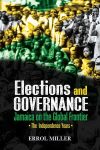
“Elections and Governance – Jamaica on the Global Frontier presented in two books: The Colonial Years, 1663 to 1962 and The Independence Years, 1962 to 2016. Together, they sketch elections and governance in Jamaica as a colony within the British Empire and as a nation-state from 1663 to 2016. Being on the global frontier locates Jamaica in the practice of elections and governance within the Western world but from the perspective of peoples subordinated in that world yet resolutely defiant of domination because of their firm embrace of freedom. The Independence Years chronicles how the nation-state has struggled with its colonial history. It highlights the dilemma of winner-take-all governance; the inherent flaws of democracy in its umbilical connection with elections, in that elected representatives can constitutionally and legally appropriate the sovereign power of the people; and outlines Jamaica’s unique attempt to resolve the paradox sustained so far by the electorate and elected representatives..”
That Miller should end such a thorough academic investigation into Jamaica’s socio- political process with a very detailed challenge to the Jamaican church is certainly significant. Clearly he believes the prophet Isaiah, “And the government shall be upon his shoulder.”
He notes that 70% of Jamaica’s population self-identify as Christians. He contends that if only 3.5% be galvanised by common strategy in united action, profound social transformation is possible for Jamaica within a generation, and lays out a credible plan for consideration.
If ever there was a nation ‘born into sin and shapen by iniquity’, a broken society needing to be fixed, a people in need of repair, Jamaica qualifies. As he says elsewhere,
The Jamaican colony was not founded on noble philosophic ideals or lofty ideological principles or an inspiring vision of human society … on the contrary, imperial plunder, economic exploitation, social inequality, and racism were the driving motive forces that shaped the society at its capture in 1655.
The great problem of course is that the Church of Jesus Christ was no innocent bystander in these bloody beginnings; indeed this ignominy was perpetrated not only with the blessing of the church but in its name. It then should not be too much to ask of Miller’s 3.5% remnant to vindicate the sullied name of their Savior in the eyes of the ‘heathen’ (that survive) by undertaking what would be a first in Jamaica’s history: ALL the church working together in concert (not in competitive fiefdoms) to heal not harm, to build not plunder, to nurture and develop not fleece and oppress.
Elijah built the altar before the fire fell. Could it be that the Glory of God so coveted by Christian devotees seeking revival is waiting upon ‘dried bones’ to connect?
Join the conversation.