The connection between unity and integrity is often missed because our modern epistemology, founded on the premise of Individualism and randomness cannot fathom a notion such as the parallelism of spheres, so intuitively grasped by ancient cultures more attune to the collective dimension than the individual and to notions of divine order rather than randomness as an organizing principle of life.
Those notions were codified and expressed invariably in truisms such as ‘All for one and one for all’, ‘As above so below’, ‘on earth as it is in heaven’, ‘As you have done it unto the least of these so you have done it unto me’, ‘the Golden Rule’, (even ‘an eye for an eye, a tooth for a tooth’ is derived from similar axioms) etc. – all these are varying iterations of one common understanding nascent to several ancient civilizations, all rooted in the common assumption of a vital connection between the microcosm and macrocosm wherein one sphere mirrors the other. Whatever philosophic tradition is based on this axiology: Ubuntu, Maat, Ifa etc, the conclusions are the same. Everything is everything, so learn to handle without from within.
The Dynamics at the level of the collective express themselves on the level of the individual, and vice versa: individual thought and action impacts collective realities, however remote, indirect, invisible or unapparent those lines of connection may be, they are assumed to exist and are seen as fundamental in Nature, and therefore the wisdom traditions of those cultures have always posited a vital connection between Unity and Integrity.
The former is conceived as the health and wholesomeness of relationships within a collective, and the latter is conceived as the health (proper function) and wholesomeness (unobstructed communication) of the integral parts of the individual. Dynamics in the one sphere are thought to mirror and imitate dynamics in the other. This as much informs the logic of Proverbs 16: 7:
“When a man’s ways please the Lord, he makes his enemies to be at peace with him.”
as the query of Jesus’ disciples:
“Who sinned, this man or his parents, that he was born blind?”
External unity and internal integrity are paralleled.
A contrasting set of internal dispositions and external praxes are derived from atomistic modernity. Unity and integrity are often placed as almost spectral opposites on a single continuum where one is only realizable at the expense of the other, where collective unity requires personal compromise and community stifles rather than affirms individuality.
. The Bible, written at the crossroads of village-life and empire contains both these veins. Concepts such as the ‘righteous remnant’, The ‘eye of a needle gateway to paradise found by but a few’, etc. delink individual exclusivity from a sense of inclusion within the collective, creating for example Jews and gentiles (yes, necessarily a capital J and common g) although one could well argue that the Divine intent of the Abrahamic call was the ultimate blessing of ‘the nations of the earth’, (common target of both Abrahamic Blessing and Great Commission) but in effect and practice, (the nations are) dissociated and heathenized in both constructs. Leaven and lump are polarized and alienated.
This is both a logical and linguistic paradox which contributes to a certain schizoid ecclesiology. Ecumenism is seen both as grand design of Satan and greatest goal of Jesus. Jesus is the answer for the world today, but only the chosen few will benefit. Identifying with the world is treasonous to the faith but necessary for its propagation. Christian doctrine seems inherently divisive. From the Babylon narrative of Gen 11 to the sword (words) of Jesus’ (Matthew 10:34-36) and St Paul, bible-quoters are not left lacking in ammunition to disturb the peace.
Even without these contradictions, the question is posed : how can the church play a role in the aspirational goal of Caribbean peoples to integrate given not just it’s historical role in establishing the status quo of oppression and divisiveness but also its own internal unresolved fragmentation and commonly perceived antipathy or arrogance in dealing with other religious identities?
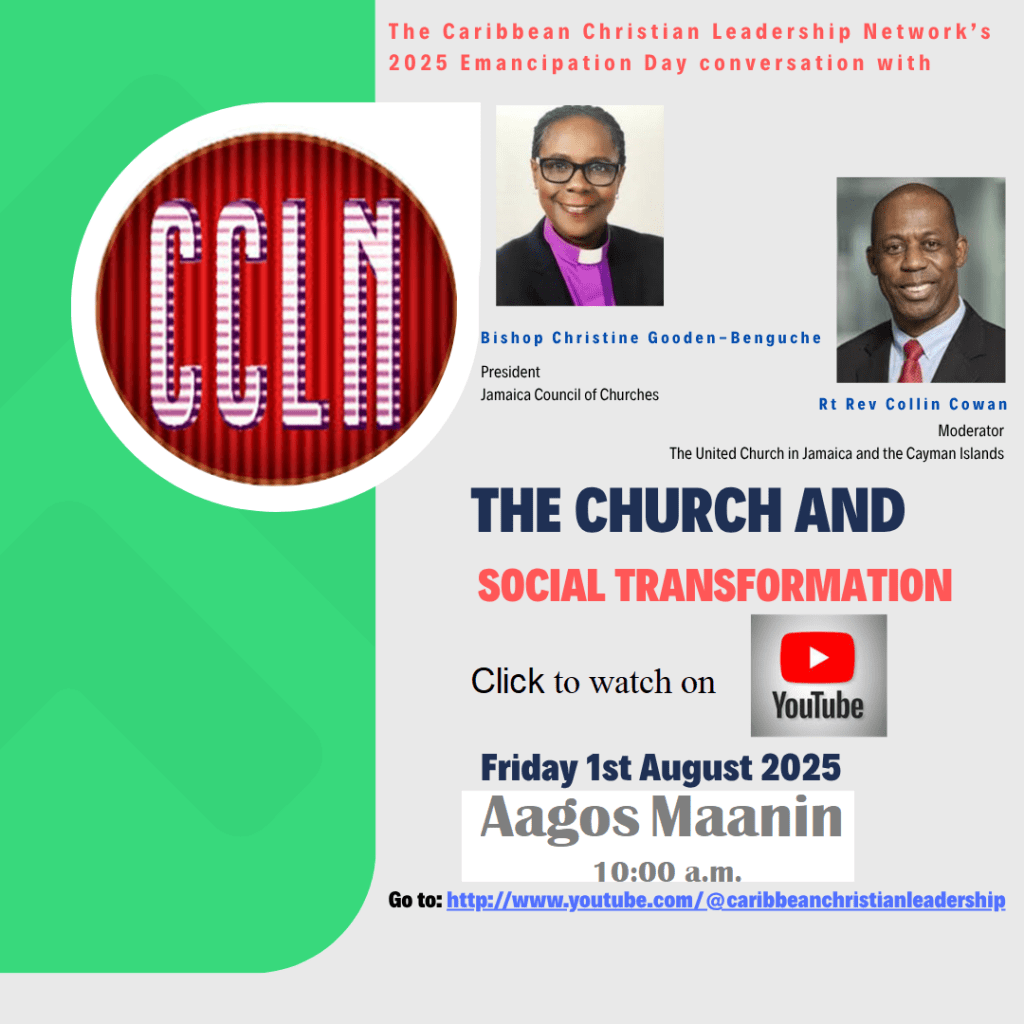
The conversation started on Emancipation Day 2025 will probably continue for a long, long time to come, but it is not entirely clear that time is a luxury we may have.