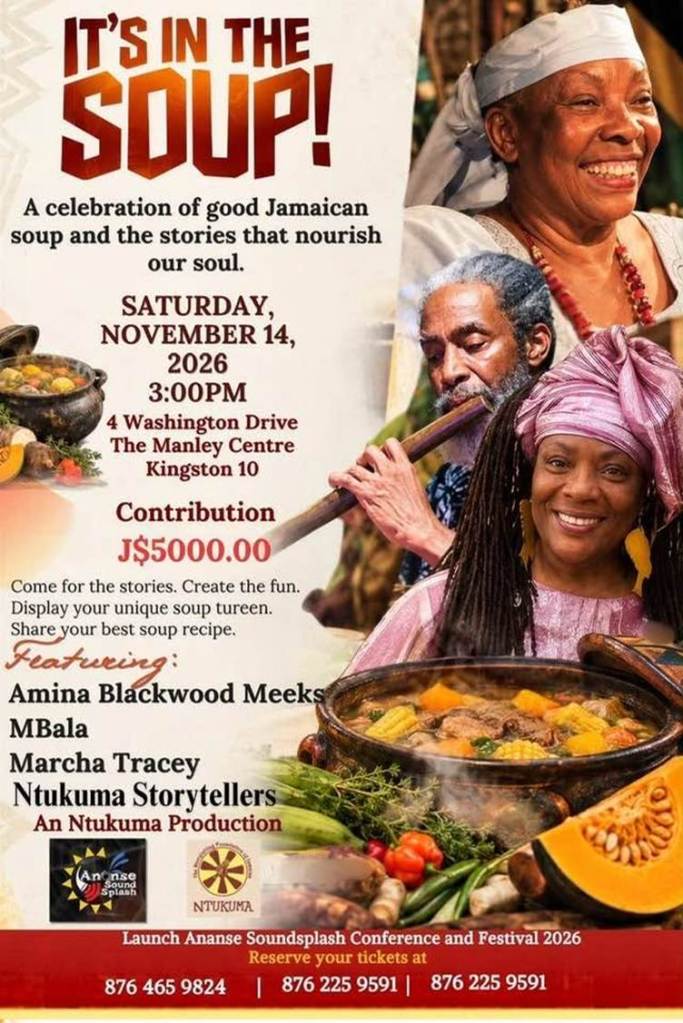
Yesterday, I attended Amina Blackwood Meek’s Soup and Story celebration at the Manley Center. It was pure joy and evoked the memory of the following story for at least 5 (five) significant reasons which I’ll mention at the end.
“Until I was three years old, my mother would carry me tied onto her back whenever she went in search of wood or grain, or simply to farm. I loved to be knitted so closely to her, to watch her collect wood and carry it home on her head singing. She loved music and perceived nature as a song. While walking any great distance, she always sang to me.
The story was always chosen to match the length of the journey, and was usually about some unfortunate girl or woman, usually an orphan. One I remember in particular was about a girl named Kula, whose mother died and left her with a little sister, Naab, to take to their aunt. Kula asked Woor, her slave, to do the packing while she dressed herself as a queen, putting on gold necklaces, rings, and beads for the journey.
Woor, who was more practical than her unmindful mistress, packed a lot of water along with her personal things. On the road Naab, the little sister that Kula carried on her back, felt thirsty and asked for water. The only person who had brought any water was Woor, but she wasn’t about to give it away for free. In payment, she asked for a gold ring. The day was terribly hot and dusty, and a little while later, Naab cried again for water.
Kula again begged Woor, this time trading her gold earrings for the water. This went on and on until the slave girl was dressed up like a queen, and Kula, stripped of her finery, looked like a slave. The next time Naab cried out for water, her sister had nothing left to trade.
Woor suggested that she herself carry the child. Thus, the three girls arrived at the house of the aunt, who welcomed them, mistaking the slave girl for her niece and the niece for the slave girl, and thus their identities were reversed. The slave girl was treated well and kept in the warm comfort of home, while the niece was treated as a slave and sent out to the farm to guard the crops against wild creatures.
As the days went on, the queen-become-slave sang the story of her life to scare the birds and animals away from the crops. A singing human voice in the middle of a farm always keeps the intruder away. As Kula cried out her plight, her tremulous melody touched the hearts of the winged and the four-legged creatures alike.
One day the Kontombili, the spirits who live in the underworld, were passing by and heard Kula’s song. They stopped and listened carefully as her mournful voice rose and fell amid the tall, end-of rainy-season grass. When she stopped to catch her breath, the Kontombili approached her and asked her to sing her song again. After she had finished, they asked, “Is this story true?” And she said, “I only sing what I know.” The Kontombili said, “Go home, little lady. Your troubles are over. Your aunt’s eyes will be opened, and she will know who you are.”
Kula went home and, as the Kontombili had promised, the aunt recognized her at once as her true niece. She was given her beautiful clothes and jewels back and placed in the bedroom where Woor the usurper had been sleeping. But Kula had learned true humility during her time as a slave, and she did not wish to switch from such hardship to such immense luxury and comfort.
She asked if she could continue to stay in the slave girl’s room and be given the leftovers from the rich folks’ meals. Dumbfounded, sorry, and confused, her aunt could only keep apologizing for having treated her so badly. Meanwhile the real slave girl was sent out to the farm to guard it against the creatures of the wild. She could not sing, so she sat and made raucous noises when birds landed on the crops.
Along came a different group of Kontombili who had been told of the farm girl and her beautiful singing. They begged her for some music, saying, “We heard that your voice brings tears to the heart. Please let us hear that song you sing every day.” Unaware who she was speaking to, Woor replied rudely, “What are you talking about? I ain’t got no song to sing to nobody.” Then she barked harshly, thinking that would scare these beings away. To the sensitive ears of Kontombili this sound was like the smell of vomit. Disgusted and puzzled, the Kontombili asked Woor once more for a real song. Answering their courtesy with rudeness, the girl rebuked them in the same way. Believing they had been deceived by the girl, the Kontombili grew so angry that they turned her to stone.
I never liked the ending to my mother’s stories. Someone always became something or someone else. When a story threatened to end before our journey did, she expertly extended it. I heard the story of Woor and Kula many times, but each time something different happened. Sometimes my mother would depict Kula’s life with greater misery, as if she guessed that I did not like the fact that the usurper was turned to stone and, therefore, wanted to make a better case for her punishment.
One time she had the little queen eat not just the crumbs from the table but had her share her meals with the dog. “But, Mom,” I protested, “she didn’t do that the other day. She ate only the leftovers.” “Yes,” answered my mother, “but if she eats what the dog eats, then she can all the more enjoy returning to her queenhood, and you can enjoy watching the wicked slave die.”
For those who think that dogs eat dog food in Dagara land, let them know that dog food is human excrement. Although her songs were sweet, my mother’s tremulous voice made me wonder sometimes if she was not mourning something or someone. I was too young then to suspect that her life and her marriage were not as happy as I thought, and that her heart held hidden sadness.”
Excerpt from Of Water and Spirit – Prof Malidoma Somé
*The Kontombile, indigenous spirit beings of the Dagara people from Burkino Faso, themselves seem to have transmogrified into orisha as Candomble in Brazil. The TransAtlantic Slave Trade changed men and gods alike from both African and European continents. Certainly the Apostle Paul would not either have recognized the Jesus Christ that arrived in the Americas on the slave ships.)
1) The 1st and least significant reason this story comes to mind is that the narrative bears some semblance of resemblance to one of the Ananse stories Amina told last night.
2) More importantly, the story reveals, upon contemplation, the basic purpose of storytelling technology in society (African or any other). It is the mechanism of shaping identity, something called euphemistically in our theological seminaries spiritual formation; from another perspective, what some people call enculturation, others still values formation. My question was and is: theorists and practitioners alike treat these words as part of quite distinct language games in purportedly different fields of engagement and inquiry, although I can’t tell them apart in essence, begging the question, is it me? or is there a hiccup in our epistemology? (wouldn’t be the first such). Rub culture out of the human brain. What’s left? To me, nothing at all. All we are is stories. (Leave my punctuation alone. It’s the English language that’s limited, not my thought.)
3) Of greater importance yet is the recognition of the parity or complementarity shared between music and lyricism (song and story) in this two pronged approach to mind programming (or you could call it something more palatable, like the ‘identity shaping’ we started out with), hence the title to this piece – a thing underlined by the fact that my day yesterday began focused on the music side of the equation and ended with the story telling aspect – both aspects of what I define as the worship component of the human soul – celebratory music and inspiring lyricism. Pathos (passion) and Logos (logic) married; ‘in Spirit and in Truth’ – a process I define as the engine of any/all human transformation. Stories inform and transform the psyche/spirit and as any psychologist or spiritual counsellor understands, changing your story changes you.
4) All this relates to the insight I profess but really am in the process of testing against challenging hypotheses. Is there any fundamental difference between what African griots and mothers did by tradition for thousands of years and the traditions which usurped / replaced it in East and West, which relegates the bulk of storytelling to a weekly holy day, whether Friday, Saturday or Sunday, credentialling an elite priesthood with the craft of relating fixed stories from Quran, Torah or Bible? (Obviously there are significant differences as I pointed out in my deliberations on distinctive European and African approaches to the Divine and to the Divine Word (The ancient Egyptian Medu Ntr), but are the differences fundamental? Is it not the same process, if not the same stories or songs?) And if it’s the same process but different software, we might ask ourself an even deeper question, so after all our cumulative experience and exchanges, who are we now?
4+1) The ongoing Caribbean identity crisis being perpetuated by the lack of collective interest in fostering real conversation between the clashing cultures within our space, typified by the present interlocutory gridlock on reparations which, even with recent advances inching forward as the church once again (or sections thereof) shifts its centre of gravity away from the status quo, reluctantly acknowledging its responsibilities in creating it, still is sustained by unresolved questions most prefer to whistle and sweep under the rug. This whole vexatious idea of Sacred Stories and how they shape us, as my regular readers will have surmised by now, is a constant theme of inquiry for me, as indicated the last time Maildoma was on my mind.
Discover more from YeKengalé
Subscribe to get the latest posts sent to your email.

