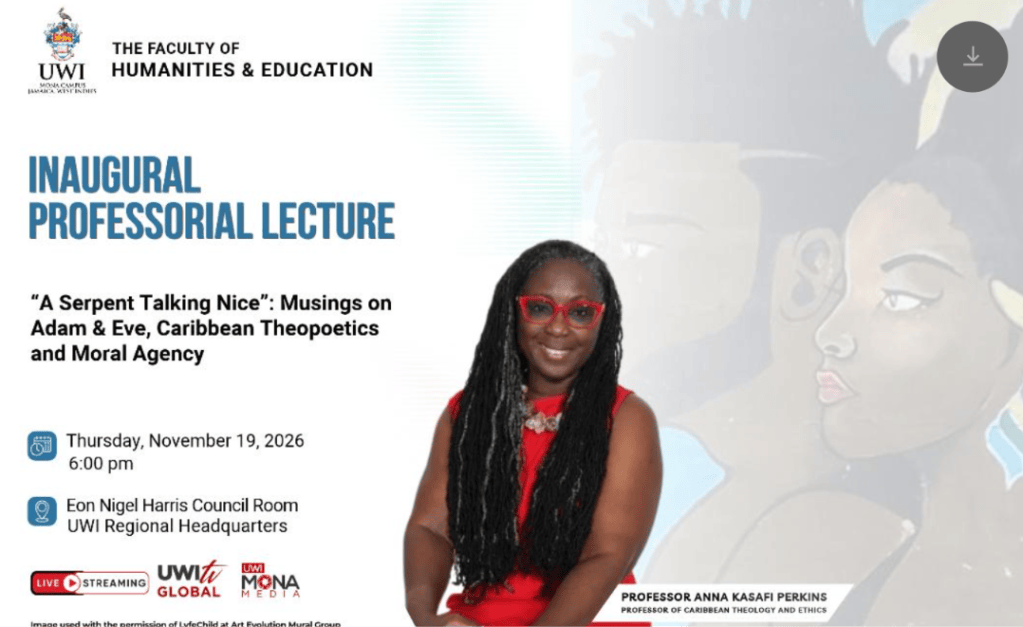
Today was International Men’s Day and the fact that this was the day chosen by a womanist theologian to publicly put a spin on The Eve and Adam story, making Eve the protagonist, the only human in the garden to allegedly escape a curse, (yes that’s quite a spin ball for traditional cricketers, and released with such speed it caught batsman, wicketer and umpire completely by surprise if the reactions of the Roman Catholic Archbishop of Kingston is any gauge) is probably no coincidence.
Well, being one of the few men for whom female empowerment has always been a welcome phenomenon, and by no means have I ever felt that this movement in any way shape or form has necessarily meant male marginalization, as if joint power between genders (or races or any other category of human being) is not conceivable or pragmatic, and being unashamedly male, since it is a day to celebrate masculinity, I do have a few things to say.
I have no problem with spinning stories, since that is what we do by default by simply being individual choicemakers, as I discuss in Sacred Stories. The narrative is ours to interpret and to tell. However I absolutely share the Archbishop’s concern that the discourse, which seemed like a forensic pathology of moral evasion, failed to even faintly describe what true moral responsibility looks like. And I have those concerns not because I wish to reinforce any of the traditional certainties and orthodoxies that Anna has empowered herself to publicly question. And make no mistake, this is exactly how I see Anna’s story. A story of self-empowerment. Learning the rules. Studying the game. Making moves to set up a long term win.
It’s a story I recognize very well from having studied the most powerful wo/man in Jamaica, as I have called my late mother. I have long understood how the tail can wag the dog. My mother, even without a first degree from a university, demonstrated the power of the spider who spins its house from threads from its own belly. Not a brick or stone from outside itself is needed to furnish its own satisfaction. I could write stories about her vanquishing opponents who outranked her in every way: wealth, education, status, office etc. but so as not to embarrass the living or relatives of the deceased, I refrain. I know though, having learned from her, that human power and authority are always being negotiated, no matter what the rules say. And above all, that whether learned from the Spidery Ananse or from Jesus the Christ: The Kingdom of God is within you.
(Perhaps that is the missing piece in the narrative heard tonight. Even as Christians, we still in the Caribbean picture God … and consequently Power as constructed and negotiated with from outside of ourselves. The shame / guilt / fear complex produced from that outdated theology will never produce competent moral agency nor can it concieve a spirituality of sufficient fortitude and magnaminity to willingly accept moral responsibility. Well that’s what my talking snake (I know, it sounds blasphemous to call Jesus a snake, but I got the idea from Him actually, John 3: 14-15; and his sweet talking is not only credible but authorized Heb 12:24-25) cured once and for all, certainly in me and many of my exemplars in Christian Faith, several of them from within the tradition of the Roman Catholic Church.)
Having listened to the encomiums heaped upon Anna in the introduction, I thought it necessary to remind her, that the University does not give her a voice, only recognize it. When institutions, even institutions with as much weight and clout as carries the UWI, especially these days when under sound governance it has leaped hurdles to capture international prestige and endorsement as one of the great tertiary centers of excellence in the world, or even exponentially more weighty institutions such as the Roman Catholic Church, arguably the most established, entrenched and powerful institution in all the Western world, when human institutions begin to see themselves as sources of power, rather than custodians of it, this is how orthodoxies are born.
Orthodoxies can be extremely useful, until they aren’t. And then the problem is how to convince something no longer useful to change or yield. The tremendous tension with negotiating within religious Orthodoxies is that Faith defines itself by belief. The 2.6 Billion Christians connected to the 7000+ denominational streams worldwide define themselves as Believers, not Thinkers. Of course, believers think, but their thinking does not define their faith, certainly not for the majority of Christians. Their belief(s) do(es). The tiny majority for whom it works the other way, (their thinking defines their Christian beliefs) have only indirect influence upon the practice of faith, and are often seen as hostile to a faith premised on a closed canon of thought.
My problem however with Anna’s presentation goes beyond genderized theology, epistemology, and theo-politics. I genuinely believe that what the Caribbean is best served by is a fleshed out example of what moral agency coupled to moral responsibility looks like. Sometimes life answers don’t come by interior interrogation (sometimes they do). Sometimes examples are simply more compelling. Our social order need to see moral responsibility modelled out because it is simply alien to our understanding having grown up under the whip and chain. That’s all we know, and it does not help when our theologies reinforce this created order. For this reason, I hope future attention is given here.
But a moral philosopher, male or female, cannot be burdened with the weight of the world, I suppose. Perhaps that’s why my faith is anchored in a man I can best relate with. The man Christ Jesus. The only talking snake I trust. The one who was lifted up on a pole as exhibit A to demonstrate that moral responsibility goes beyond a mere accounting for one’s own actions and encompasses the willingness to sacrifice in order to fix things, regardless of who is to be blamed for breaking them in the first place.
I dont have a gender axe to grind. And if some do, they can tell their own stories. Truth is, the stories that most capture the imagination are those that are real. Real not just in the sense of historical, but in the sense of transcendent.
I am deeply suspicious when any human institution begins to see itself as an authority on the transcendent. Jesus had to contend with the Pharisees. When I hear folly like
“At long last the Caribbean now speaks for itself and the duppy of colonial theology is now vanquished…’ because of what??? a woman now sitting in your professorial chair? I can only hope that such exuberance is the kind of hyperbole we all can get carried away with at such a joyous milestone of a truly remarkable colleague and not the intellectual arrogance of those whose weight of learning has begun to tempt them into thinking of themselves much more highly than is appropriate.
Not only have we been theologizing and speaking for ourselves for a long time, but the truths of moral responsibility and human equality across gender (and other categories) are much more ancient than this fledgling university of which we are all proud that has done so well in our time. Many others have custoded these truths before us, some of them without a drop of literacy to their credit, oft in language unspoken much less anything near the elaborate sophistry that sometimes lends itself to clear understanding, and other times simply occludes it.
But yes, it is now well overdue the time that these truths should be universally acknowledged, reflected, upheld and practiced in all our institutions and commonly among our peoples. So, may our University produce scholars and our churches produce leaders and followers who understand the principles of quality of service and the equality of server and served so perfectly modelled both by Jesus and His mother in the Biblical narrative and those exemplary ancestors who have kept faith with conscience and provided inspiration for us who now run the race.
But, however, should our University begin to see itself instead as an arbiter of righteousness or broker of power in either domain of church or state, it is eating the leaven of the pharisees and destined to become another one of the orthodoxies eventually eschewed by a society whose creativity rather than being served by it, soon becomes stifled by a people so full of themselves and their own learning they haven’t the space to truly recognize much less help develop without tainting the innate worth and value of and in others, which is the human dignity the institution is called to enhance, not legislate, certainly not impart.
Discover more from YeKengalé
Subscribe to get the latest posts sent to your email.

